October 13, 2026
Zoho People vs OpportuneHR: Pricing, Features & India Fit Compared (2026)
ReadDiscover Why OpportuneHR is the best HRMS Software in India! Schedule a Demo OR Call us @ +91 7700-954949


 Visited 21 times


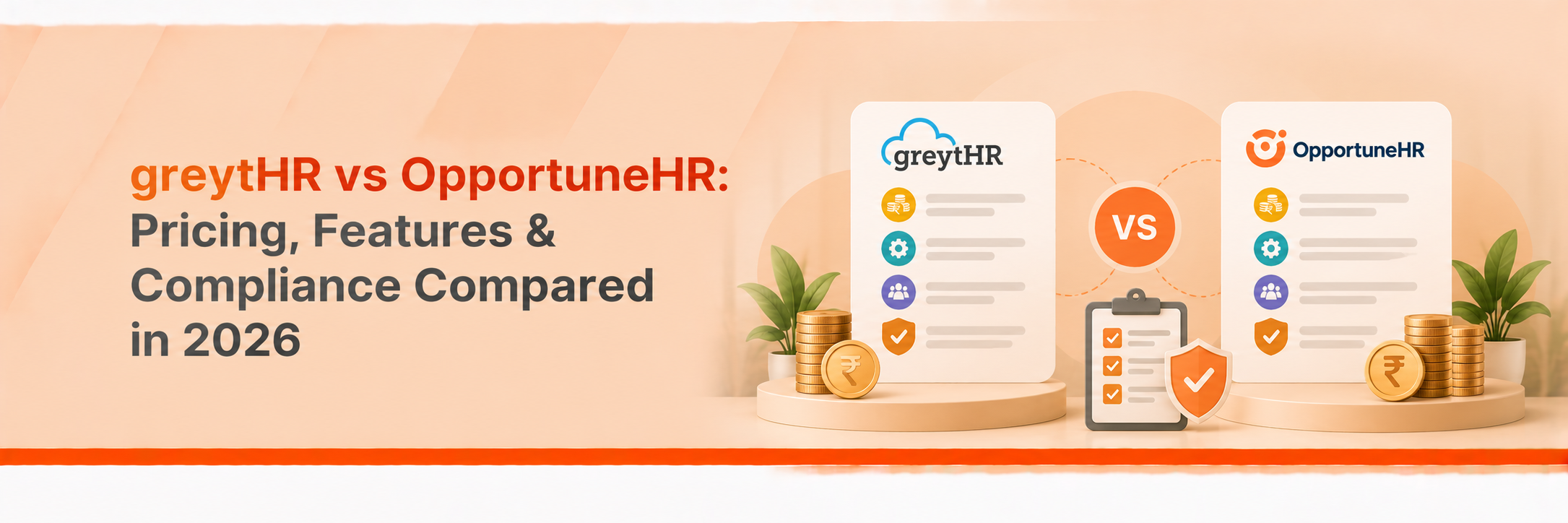
If you’re looking for HRMS software for your company, you’ve probably come across greytHR.
And for good reason. It has been in the Indian HR and payroll space for years and is particularly well known for payroll and statutory compliance.
But there is another question growing businesses are asking:
“Is greytHR still the right fit for us, or should we look at alternatives such as OpportuneHR?”
That’s where an honest comparison helps.
Both platforms cover core HR, attendance, leave and payroll. But their approach, pricing structure, customization and overall experience can be different.
So, rather than asking which one is “better”, let’s look at where each platform may make more sense.

| Area | greytHR | OpportuneHR |
| Core HR | Yes | Yes |
| Payroll | Yes | Yes |
| Attendance & Leave | Yes | Yes |
| Indian statutory compliance | Strong | Strong |
| Employee self-service | Yes | Yes |
| Performance Management | Available | Yes |
| Recruitment | Available as add-on | Yes |
| HR analytics & reports | Yes | Yes |
| AI capabilities | AI-powered chatbot/NAVOS | AI-enabled HR capabilities |
| Customization | Available | Strong customization focus |
| SME suitability | Strong | Strong |
| Payroll pricing | Published plans | Published PEPM range |
| Implementation/support | Available | Hands-on implementation & Tele support |
The exact features available can depend on the plan, add-ons and business requirements, so this table should be treated as a starting point rather than a substitute for a product demo.
One of greytHR’s biggest advantages is pricing transparency.
Its current published pricing shows:
The Essential plan includes payroll, leave management and core HR. Growth adds capabilities such as advanced attendance and shift management. Performance, recruitment, API, expenses and other capabilities can be available as add-ons depending on the plan.
That’s useful for SMEs because you can get a reasonably clear starting point before speaking to sales.
But remember: the starting price isn’t necessarily your final HRMS cost.
If you add performance management, recruitment, API access, GPS tracking or other modules, your actual monthly cost can increase.
OpportuneHR publicly states that its payroll pricing ranges from ₹70 to ₹150 per employee per month, depending on requirements. It also says the platform can scale as business needs grow.
The important word here is payroll.
If you’re comparing complete HRMS costs, don’t compare greytHR’s complete plan price with OpportuneHR’s payroll-only published range and assume one is automatically cheaper.
Instead, compare the same scope:
Payroll + attendance + leave + performance + recruitment + integrations + support.
That’s the only meaningful price comparison.
greytHR’s biggest strength is its long-standing focus on Indian payroll and HR operations.
Its current plans cover payroll, leave, core HR, attendance, employee self-service, workflows and reporting, while higher plans and add-ons extend the functionality. It also offers an AI-powered assistant and employee-facing capabilities.
greytHR May Suit You if:
What Should You Check?
Some capabilities are add-ons rather than part of the base plans. So before buying, calculate the total cost of the modules you actually need, not just the advertised base price.
OpportuneHR takes a broader, scenario-based approach to HR automation.
Its HRMS covers areas including employee management, attendance, leave, payroll, taxation, statutory compliance, performance management, recruitment and employee lifecycle processes.
One of its key differentiators is customization.
This can matter when your company has a slightly unusual payroll structure, approval process, attendance policy or reporting requirement.
Its payroll platform also supports integrations with systems such as Tally and SAP through APIs.
OpportuneHR May Suit You if:
OpportuneHR also positions its support model around its opportune.Care approach, which focuses on ongoing customer support rather than treating implementation as the end of the relationship.
For Indian businesses, this may actually be the most important part of the comparison.
Payroll compliance isn’t just about deducting PF and ESI.
There are state-specific requirements, Professional Tax, Labour Welfare Fund, TDS, statutory reports, minimum wage considerations and other obligations to manage.
greytHR highlights compliance capabilities covering areas such as PF, ESI, PT, TDS, LWF and gratuity, along with statutory reports and state-specific compliance support.
OpportuneHR similarly supports PF, ESIC, PT, LWF, statutory bonus, gratuity and state-wise compliance, along with reports such as PF ECR, ESIC and PT registers.
So, on paper, both are strong options for Indian payroll compliance.
The real test is different.
Take your actual payroll scenarios into the demo and ask both vendors to process them.
That’s where the difference becomes clearer.
A useful greytHR review shouldn’t simply say “greytHR is good.”
Its strengths are clear: established Indian payroll capabilities, transparent pricing, broad HR functionality and a strong compliance focus.
But businesses should also evaluate whether the required modules are included in their selected plan or available as add-ons.
The same principle applies to OpportuneHR.
Its customization and Indian payroll focus can be valuable, but companies with highly complex international HR requirements should check whether the platform meets those specific needs.
If you’re searching for greytHR alternatives, don’t immediately look for another software with more features.
First ask why you’re considering a switch.
Is it:
Depending on the requirement, businesses may compare platforms such as OpportuneHR, Keka, Zoho People, HROne and other Indian HRMS solutions.
And yes, greytHR competitors can look very different depending on whether you’re an SME, mid-sized company or enterprise.
The greytHR vs Keka comparison comes up frequently because both platforms serve Indian businesses but have somewhat different positioning.
greytHR emphasizes payroll, compliance and operational HR, while Keka is widely positioned around modern HR workflows and employee experience.
If you’re already comparing greytHR and Keka, adding OpportuneHR to the shortlist can give you another benchmark—particularly if customization, Indian payroll and hands-on support are important to your organization.
Don’t choose based on someone else’s “winner.”
Choose based on your own payroll and HR processes.
Not universally. greytHR is a strong choice for businesses prioritizing established payroll, compliance and transparent pricing. OpportuneHR may be better suited to businesses that prioritize customization, integrated HR operations and hands-on support.
greytHR currently publishes plans starting at ₹2,495/month for 50 employees on Essential and ₹4,495/month for 50 employees on Growth, with additional per-employee charges and optional add-ons.
There is no single best alternative. OpportuneHR, Keka, Zoho People and HROne are among the platforms businesses may consider depending on their HR and payroll requirements.
Both greytHR and OpportuneHR have strong Indian payroll compliance capabilities. Your decision should depend on the exact states, employee categories, salary structures and statutory reports your organization needs.
The Opportune vs greytHR decision doesn’t need to be complicated.
If you want transparent pricing and a mature Indian payroll and compliance platform, greytHR is definitely worth considering.
If you want customization, integrated HR operations, Indian payroll capabilities and hands-on support, OpportuneHR deserves a place on your shortlist.
And if you’re currently evaluating greytHR alternatives, don’t make the decision from a feature comparison table alone.
And most importantly, ask what happens after implementation when your HR team needs help.
Because the right HRMS isn’t necessarily the one with the most features.
It’s the one that makes your HR team’s everyday work easier.