September 11, 2026
greytHR vs OpportuneHR: Pricing, Features & Compliance Compared in 2026
Hr Tech, HRMs Software, Payroll
ReadDiscover Why OpportuneHR is the best HRMS Software in India! Schedule a Demo OR Call us @ +91 7700-954949


 Visited 1 times


“How much will our HRMS actually cost?”
If you’re an HR manager or business owner at an SME, this is probably one of the first questions you ask when you start looking for HR software.
And strangely, it’s not always easy to get a straight answer.
One vendor says ₹45 per employee. Another gives you a monthly package. Another says, “Let’s understand your requirements first.”
Then the questions start.
And suddenly, the price you saw on the website doesn’t look anything like the final quote.
So let’s make HR software pricing a little easier to understand.

There isn’t one standard HRMS price.
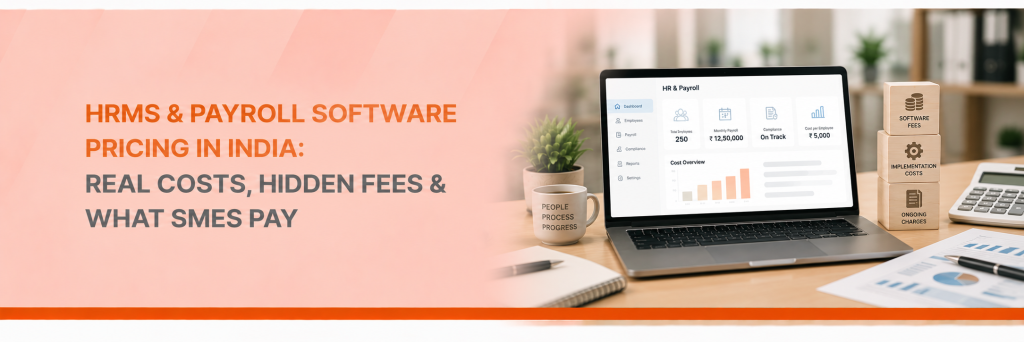
For SMEs, current cloud HRMS pricing can range from relatively low per-employee plans to ₹2,500–₹5,000+ monthly packages for entry-level systems, while more comprehensive platforms can cost considerably more. The pricing model also varies—some vendors charge per employee, some have a minimum employee slab, and others provide a custom quote.
The important thing is not just the headline price.
It’s the actual monthly cost for your company.
For example, a vendor charging ₹45 per employee may sound cheaper than a vendor charging ₹2,500 per month.
But if the ₹2,500 plan already covers 50 employees, the comparison changes.
Let’s look at some real examples.
The following examples use publicly available vendor pricing checked in 2026. They are useful for budgeting, but should not be treated as final quotations. GST, optional modules and other commercial terms may change the final amount.
| Employee strength | greytHR Essential* | factoHR Core* | HROne Basic* | Pocket HRMS Standard* |
| 25 employees | ₹2,495/month | ₹4,999/month | ₹4,950/month | ₹2,995/month |
| 50 employees | ₹2,495/month | ₹4,999/month | ₹4,950/month | ₹2,995/month |
| 100 employees | ₹4,745/month | ₹8,449/month | ₹9,900/month | ₹5,995/month |
| 250 employees | ₹11,495/month | ₹21,799/month | ₹24,750/month | ₹14,995/month |
Illustrative calculation from publicly listed base/slab pricing; actual commercial quotes may vary.
For example:
Something quite important.
The cheapest-looking per-employee rate isn’t necessarily the cheapest package.
If you have only 25 employees, a plan with a 50-employee minimum means you’re effectively paying for employees you don’t currently have.
At 100 or 250 employees, however, the economics can change significantly.
That’s why you should always calculate the price based on your actual employee count.
This is where HRMS pricing becomes a little less straightforward.
Keka offers HRMS and payroll plans, but its official pricing page currently asks prospective customers to get in touch rather than displaying a simple rupee price for every plan. Keka does publish its plan structure and features, but the final commercial quote depends on the requirements.
Keka has also published a 2026 payroll-software comparison showing a Foundation plan at ₹9,999/month for 100 employees, but buyers should verify the current commercial offer directly with Keka before using that number for budgeting.
Darwinbox follows a more sales-led pricing model, so SMEs should expect to request a quote rather than rely on a public monthly price.
And that’s an important lesson:
“Price not published” doesn’t mean “expensive.”
It simply means you need to compare the vendor through a quote or demo.
OpportuneHR currently publishes payroll pricing of ₹30–₹60 per employee per month, depending on requirements. The company says businesses can start small and scale as their requirements grow.
However, there is an important distinction here.
That is published payroll pricing, not necessarily the price of every HRMS module.
If you’re comparing OpportuneHR with another full HRMS, you should ask for pricing based on the same scope:
HR + attendance + leave + payroll + compliance + performance + recruitment + integrations + support.
That’s the only fair comparison.
This is where SMEs should be careful.
So when comparing payroll software price, ask what comes with the base plan.
At minimum, check whether you get:
The lowest subscription price can become expensive if HR still has to do half the work manually.
Let’s be fair here.
“Hidden cost” doesn’t always mean a vendor is hiding something.
Usually, the advertised price covers the core software, while your specific requirements create additional costs.
Implementation
Additional Modules
Integrations
Customisation
Ask:
“Can this be configured within the standard product, or will we need custom development?”
Support
And then there’s the cost nobody puts on the quotation:
HR’s time.
If your HR team spends hours every month fixing payroll data, preparing reports or following up with support, the software isn’t really saving as much as it appears to.
One small detail that can make a noticeable difference to your budget is GST.
Many published software prices are shown before 18% GST.
So if a vendor quotes ₹5,000 per month, your invoice may not actually be ₹5,000.
Ask for:
“Please share the final annual cost including GST and all mandatory charges.”
That gives finance a number they can actually work with.
Don’t use an HR software demo just to watch someone show dashboards.
Then ask the vendor:
“Show me how this works.”
Also ask:
Not necessarily.
Imagine one HRMS costs ₹20,000 more annually but saves your HR team several hours every payroll cycle.
Another costs less but still requires Excel reconciliation, manual reports and multiple follow-ups.
Which one is cheaper?
That’s the question worth asking.
The real value of HRMS isn’t just the software licence.
It’s the time saved, errors reduced, processes connected and dependency on manual work reduced.
Don’t ask:
“What’s your starting price?”
Ask:
“What will our complete annual cost be for everything we need?”
Give the vendor:
Then compare the final numbers.
That’s a much more realistic way to understand HRMS software cost.
For SMEs, publicly listed entry-level HRMS plans can range from around ₹2,500 to ₹5,000 per month, while per-employee pricing can range from roughly ₹40–₹150+ depending on the platform and features. Premium and enterprise solutions are often custom-priced.
It depends on the vendor and plan. Some platforms bundle Indian payroll into their HRMS plans, while others sell payroll separately. Always compare the complete package rather than the HRMS subscription alone.
OpportuneHR currently publishes payroll pricing of ₹15–₹50 per employee per month, depending on requirements. The final cost for a complete HRMS depends on the modules and services selected.
Ask about the total annual cost, implementation, payroll, statutory compliance, integrations, customisation, support, data migration and what happens to pricing as your employee count grows.
It’s about finding a system that makes your HR team’s everyday work easier without creating another layer of work.
So compare prices.
But also compare what’s included.
Compare implementation.
Compare support.
And most importantly, compare how the software handles your actual payroll and HR processes.
Because ₹50 per employee may look cheap on paper.
But if your HR team is still spending two days every month fixing Excel sheets, it isn’t really saving you money.
Don’t rely on a generic starting price.
Get a custom quote from OpportuneHR based on your employee strength, payroll requirements, modules, integrations and HR processes.