September 28, 2026
Attendance-to-Payroll Integration: Why Disconnected Attendance Data Costs You Every Month
ReadDiscover Why OpportuneHR is the best HRMS Software in India! Schedule a Demo OR Call us @ +91 7700-954949


 Visited 43 times


Every month, around the same time, the same thing happens in HR departments everywhere.
Someone realizes they forgot to submit their reimbursement.
A manager remembers an overtime approval that should have been processed.
An employee sends a message asking whether their leave deduction has been considered.
And suddenly, what looked like a normal week turns into a race against time to get payroll right.
If you’ve ever been involved in payroll processing, you know the feeling. The last few days of the month can be stressful. Not because payroll teams aren’t capable, but because the entire process has traditionally been built around one big deadline.
For years, we’ve accepted this as normal.
Collect all the data. Verify everything. Run payroll. Release salaries.
Then repeat it all again next month.
But lately, I’ve been wondering: why are we still treating payroll like a monthly event?

Think about how much the workplace has evolved over the last decade.
Employees can apply for leave from their phones. Attendance is tracked instantly. Expense claims are submitted online. Managers approve requests with a click.
Almost every HR process has become digital and real-time.
Except payroll.
In many organizations, payroll still waits until the end of the month to pull together all the information that has already been available for weeks.
It feels a little like saving all your emails for the last day of the month and then trying to answer them at once.
What often gets overlooked is the amount of effort that goes into making payroll look effortless.
Employees see a salary credit notification and assume everything happened automatically.
Behind the scenes, however, payroll and HR teams spend countless hours checking records, validating data, answering queries, and fixing discrepancies.
Most of the time, nobody notices that work—and that’s actually a sign that payroll has been done well.
But it also means that payroll professionals are constantly working under pressure to ensure there are no mistakes.
Because unlike many other business processes, payroll doesn’t leave much room for error.
When a report is delayed, people may not notice.
When a salary is incorrect, they definitely do.
One thing I’ve noticed over the years is that employees rarely worry about payroll until something feels unclear.
They want to know:
“Was my reimbursement included?”
“Has my overtime been approved?”
“Why is my take-home salary different this month?”
These questions aren’t really about money.
They’re about certainty.
People plan their lives around their salaries. They budget for rent, school fees, EMIs, investments, and household expenses. Naturally, they want confidence that everything has been calculated correctly.
Waiting until payday to discover a discrepancy can be frustrating for employees and equally challenging for HR teams.
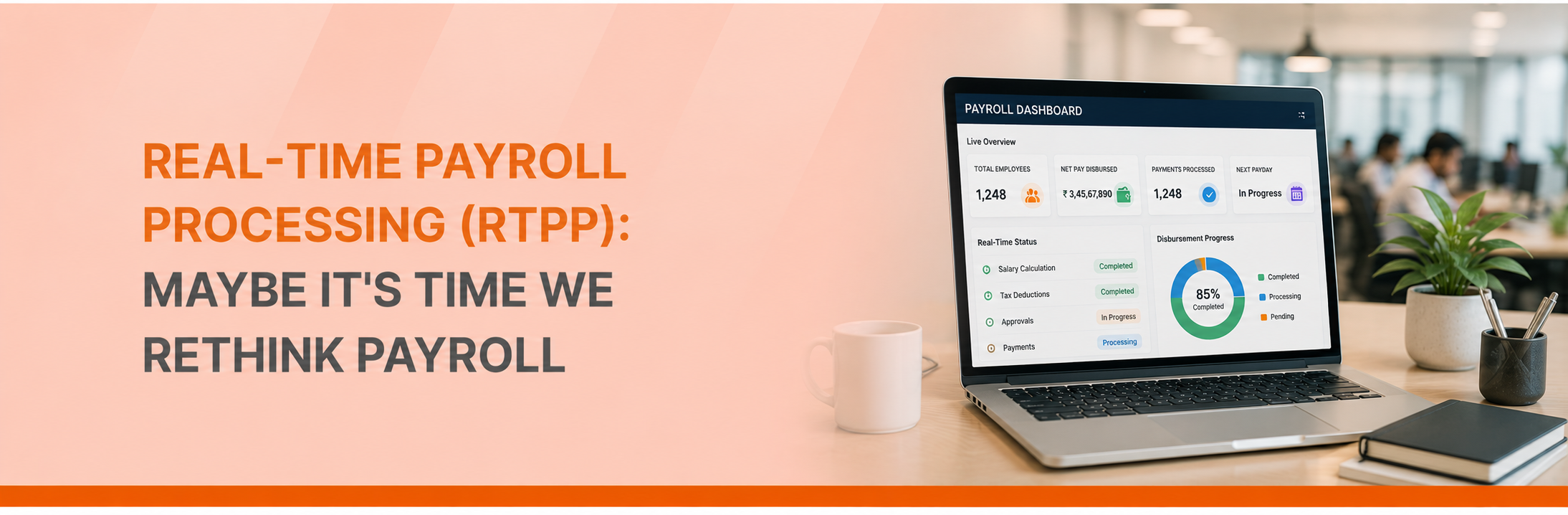
The idea behind Real-Time Payroll Processing is surprisingly simple.
Instead of waiting until month-end to calculate everything, payroll information is updated continuously.
Leave records, attendance, reimbursements, incentives, overtime—everything flows into the system as it happens.
A modern payroll software solution can keep calculations updated throughout the month, rather than creating a rush at the end.
The benefit isn’t just speed.
It’s visibility.
Employees gain a clearer understanding of their earnings. HR teams gain more time to identify issues before they become problems. Managers gain better visibility into workforce costs.
Everyone spends less time chasing information.
For a long time, payroll was viewed as a back-office function.
Today, employees see it differently.
The same employee who can track a food delivery in real time also expects transparency at work. They expect information to be accessible. They expect systems to communicate clearly.
That’s why many organizations are investing in a smarter payroll platform—not simply to automate calculations, but to create a better experience.
Because payroll isn’t only about compliance or processing.
It’s one of the most visible ways an organization demonstrates reliability.
Employees may forget many workplace interactions, but they rarely forget payroll mistakes.
The monthly payroll cycle isn’t disappearing tomorrow, and for many businesses it will remain the standard for years to come.
But the mindset around payroll is changing.
Instead of treating payroll as a task that happens once a month, organizations are beginning to view it as an ongoing process—one that should be accurate, transparent, and continuously updated.
And honestly, that feels like a much more sensible way forward.
After all, payroll is not just about numbers.
It’s about people trusting that the work they’ve done will be recognized, recorded, and rewarded correctly.
When you look at it that way, Real-Time Payroll Processing isn’t really a technology shift.
It’s a people shift.