September 25, 2026
HR & Payroll Software for Manufacturing Companies in India
ReadDiscover Why OpportuneHR is the best HRMS Software in India! Schedule a Demo OR Call us @ +91 7700-954949



 Visited 35 times


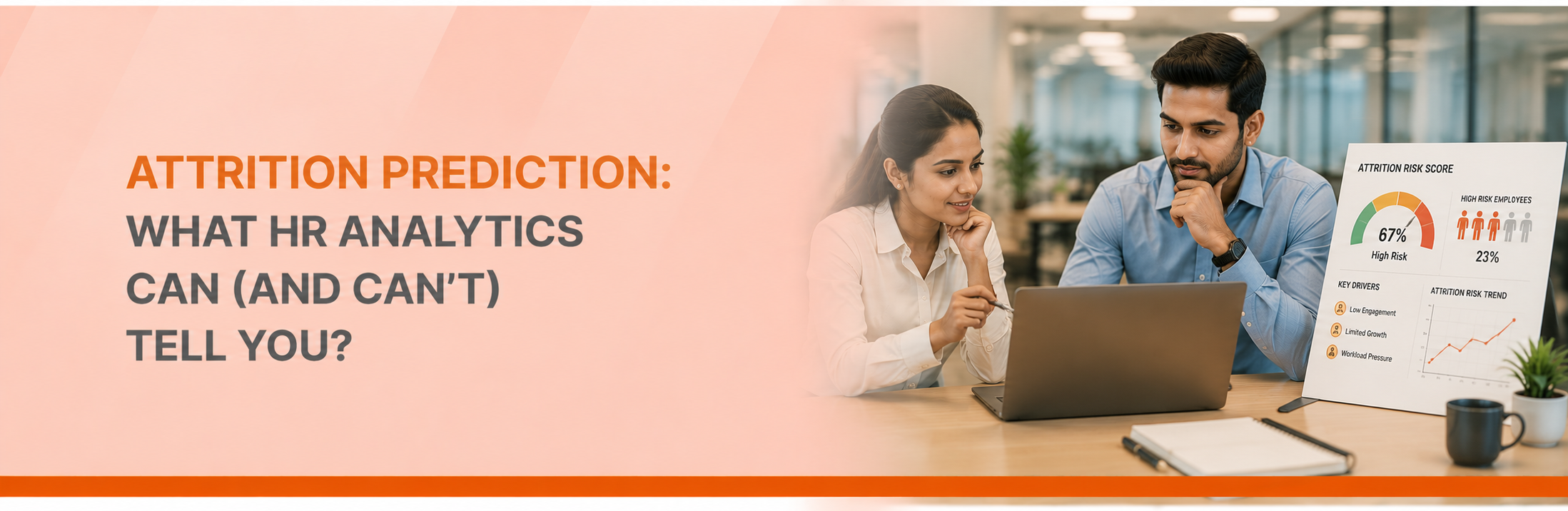
Ask any business owner and Attrition Prediction is high on their list. Rather, it is one of their silent fears– What if my good people leave the organisation?
The reason is, they make all their plans around such people. If anyone leaves, the production cycles get disrupted. And in case they are from sales, good relationships with clients also are lost.
On the other hand, it hurts financially, too. As per Society for Human Resource Management (SHRM), replacing an employee can cost about 6 to 9 months of that employee’s salary.
So, the business owners are curious, if HR Analytics can predict attrition? Not just the general trend, but the probability that a particular employee may leave.
The answer is a conditional- Yes. There is a probability of 70% accuracy if relevant data points are captured. And sophisticated models like Logistic Regression Models are used along with Machine Learning Algorithms. Experts also use Survival Analysis and Segmentation Analysis for better accuracy.

The predictive analysis works on the assumption that historical data can be used to predict future trends. And in ongoing, regular work scenarios, it is true.
Businesses aren’t aware, but HR Automation platforms like HRMS software capture a huge amount of data. In the hands of a good predictive analyst these data can generate insightful patterns.
When we compare current datasets with these past patterns, it reveals the probability of attrition in your organisation.
For example, increasing absenteeism and medical leaves and lesser number of employees in training programs can also show glaring signals about possible attrition.
The increase or decrease may be minimal, but a consistent pattern can predict attrition scenarios well in advance.
What are key indicators of employee attrition?
The attrition prediction analysis is quite matured by now. And what works, and what doesn’t is pretty known to analysts as well as HR experts.
Here are some of the key indicators of attrition prediction through HR analytics–
Engagement and satisfaction matrics–
Employee engagement surveys are a good way to analyse and predict employee attrition probability. Any declining engagement scores, especially if it happens continuously, is a signal that possibility of employee departure is more in that particular department.
If it is about a person, lowering scores suggest that corrective action must be taken in time to retain that employee.
Performance Data–
Studies show some interesting patterns here. Both unusually high performance and low performance show a higher risk of an employee leaving the organisation.
High performers often pursue opportunities out of the organisation for better salaries and higher responsibilities in other organisations. While low performers sense a probability that they may be asked to leave. And they start looking for outside opportunities.
Compensation and benefit analysis–
Employees always compare their own salaries and benefits with others. When their compensation falls below the market rate, it starts bothering them and they look for better opportunities. Also, if some of their colleagues move up the ladder and get better increments and compensation, there is a likelihood that these people would consider moving to other organisations.
Behavioural changes–
Analysis can show a shift in behaviour of a person – for example, a decline in training participation, a decrease in the level of collaboration between employees, an increase in absenteeism in a particular department are a sign of possible attrition.
The same applies to a single individual.
Tenure patterns. There are two kinds of signals here. One is the general tenure pattern of people in the organisation. For example, if a high percentage of new hires leave within 6 months of joining, it is a signal to HR that better onboarding is a need. And they must keep a special eye on such employees.
On the other hand, there is general data which shows that typically around a tenure of 18 to 24 months in an organisation, people leave. There are some other milestone tenures like 5 years or 10 years.
In such cases, people start re‑evaluating their past decisions and may want to try new opportunities.
The attrition analysis is useful only when there is a well defined retention strategy in place. And companies use many such employee retention approaches.
In such cases, attrition prediction signals are taken into account seriously. And HR takes corrective actions.
For example, if a particular department shows a high level of attrition or a shorter tenure in comparison to other departments, the policies can be revised, or, in some cases, managerial training may be required.
Another use case of attrition prediction is making timely retention interventions. Rather than the usual appraisal or feedback, a manager can have a one‑to‑one conversation with such employees and address their specific concerns. HR can also go beyond routine policy to make exceptions to retain these employees.
Many organisations do not just focus on retaining employees; they also continuously engage in succession planning. So if good talent leaves, they always have someone else ready to take their position.
In case higher attrition rates are seen throughout the organisation, the compensation strategy must be re‑evaluated and salaries should be made competitive with other players in the industry.
HR analytics has its limitations, and even the most sophisticated models can only predict occurrence up to 85%.
And there are reasons. HR analysis can only predict as per available data, but there are factors which are external.
For example, parental pressures or family circumstances. Sometimes the spouse relocates to a new city or other side of a metro town. There are health considerations, too.
And sometimes even when all engagement signals show positive engagement with the company, a sudden outside opportunity may arise and an employee would like to take it.
So while attrition analysis is good and reliable for showing us probabilities, one cannot rely on them alone.
Another important point is that attrition prediction works best with larger data sets. Many SME organisations may not have enough statistical data, and in such cases the analysis can falter.
But still in such cases, wise business owners and HR managers can use the patterns to take corrective action. As they say, humans in the loop can make a difference.
Predictive analysis is quite mature by now. Sophesticated models can achieve results up to 85% accuracy. 60 to 75% accuracy is quite common. Such analysis has its limitations because it can work only with the available data in HR platforms. When there are external factors, the results vary.