October 3, 2026
HR & Payroll Software for Manufacturing Companies in India
ReadDiscover Why OpportuneHR is the best HRMS Software in India! Schedule a Demo OR Call us @ +91 7700-954949


 Visited 1 times


Imagine you are running HR for a growing company with 300 employees.
Payroll is getting more complex, employees want access to their payslips and leave balances, managers need attendance data, and HR is spending too much time maintaining spreadsheets.
So, you decide it is time to invest in an HRMS.
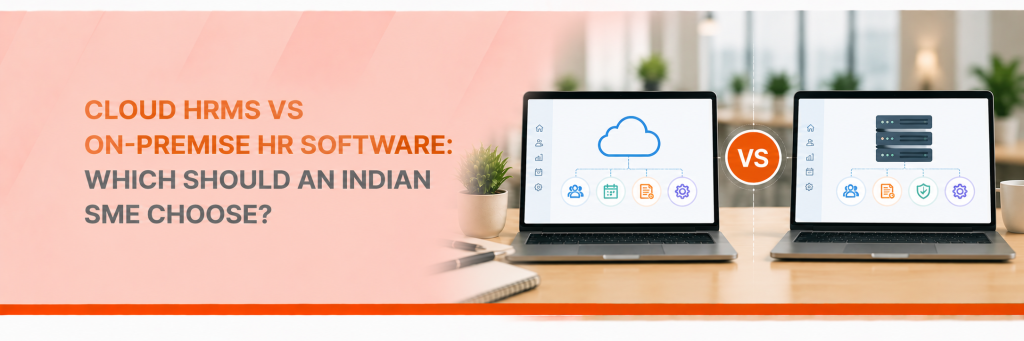
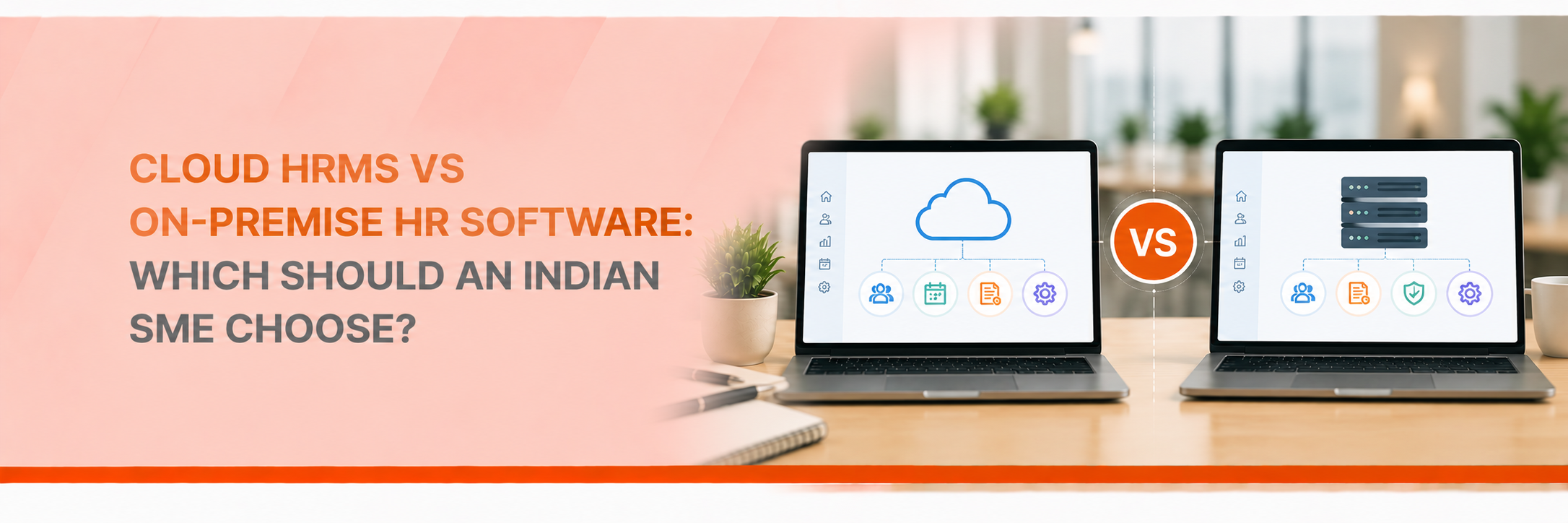
But then comes another question: Should you choose a cloud-based HRMS or an on-premise HR software?
For many Indian SMEs, this decision is less about technology and more about cost, convenience, security, scalability and how much IT support the business actually has.
Let’s break it down.

A cloud based HRMS is hosted by the software provider and accessed through the internet.
There is no need for your company to install the HR software on its own servers. HR teams, employees and managers can access the system through a browser or mobile application, depending on the solution.
For a growing SME, this can be useful because the company doesn’t have to build and maintain an entire IT infrastructure just to run HR operations.
With a cloud HRMS, activities such as employee management, attendance, leave, payroll, recruitment and performance management can be managed from one platform.
With on premise HR software, the software and its associated infrastructure are hosted within the company’s own IT environment.
The organisation generally has greater control over the infrastructure, data environment and internal system management.
This model can make sense for organisations with specific infrastructure, security or internal IT requirements.
However, it can also mean additional responsibility for servers, maintenance, upgrades, backups and technical support.
And this is where the cloud HRMS vs on premise discussion becomes important for SMEs.
There is no universal winner. The better option depends on the organisation.
An on-premise setup may involve infrastructure, servers, implementation and IT resources.
A cloud HRMS generally follows a subscription-based model, reducing the need for businesses to invest heavily in infrastructure upfront.
For an SME trying to manage technology costs carefully, this can make cloud a more practical option.
Ask yourself:
Who will maintain the system after implementation?
With on-premise HR software, internal IT teams may need to handle infrastructure, backups, upgrades and technical issues.
With a cloud HRMS, much of the infrastructure management is handled by the service provider.
That allows HR and IT teams to focus more on business requirements rather than maintaining HR technology.
Modern HR doesn’t happen only from an HR manager’s desktop.
Managers may need to approve leave while travelling. Employees may want to check attendance or download payslips from their phones.
This is one reason cloud HR software India users are increasingly considering cloud-based platforms.
The ability to access HR information remotely can be especially useful for companies with multiple offices, locations or hybrid teams.
Your HR software should not become a problem when your company grows.
Suppose you move from 200 employees to 500 or 1,000.
A scalable SaaS HRMS can make it easier to add employees, departments, locations and processes without rebuilding the entire infrastructure.
This is particularly relevant for Indian SMEs that are growing quickly.
Indian payroll and HR processes can involve PF, ESI, PT, TDS, leave rules and other statutory requirements.
Your HRMS therefore needs to stay aligned with changing business and compliance requirements.
With a cloud model, software updates can generally be managed centrally by the provider rather than requiring every customer to manually install updates.
Still, don’t simply take a vendor’s word for it.
Ask how frequently the system is updated and how compliance changes are handled.
Not necessarily.
This is one of the biggest misconceptions in the cloud HRMS vs on premise debate.
Security depends on how the system is designed, configured, monitored and maintained.
A company choosing on-premise HR software still needs strong access controls, backups, security monitoring and disaster recovery processes.
Similarly, a cloud HRMS provider needs strong security practices and appropriate controls around data protection.
Instead of asking only, “Is it cloud or on-premise?”, ask:
How is my employee data protected?
For many growing SMEs, a cloud based HRMS can be the more practical choice because it can offer:
But that doesn’t mean on-premise is obsolete.
Organisations with highly specific infrastructure, internal IT policies or particular data-hosting requirements may still prefer an on-premise approach.
The right question is not “Which technology is better?”
It is:
“Which model fits our business, people, budget and future growth?”
Before signing a contract, ask the vendor:
These questions will tell you much more than simply comparing a list of features.
The biggest advantage of a cloud HRMS isn’t simply that it is hosted online.
It is the ability to give HR a system that can grow with the business without constantly adding infrastructure and manual work.
For example, a growing company may start with employee records, attendance and leave. Later, it may need payroll, recruitment, onboarding, performance management, compliance, analytics and employee self-service.
A well-designed HRMS should allow those processes to work together instead of creating another disconnected system for every HR requirement.
That is where solutions such as OpportuneHR can fit into the conversation—with integrated HR, attendance, payroll, employee lifecycle management, workflows, reports and compliance capabilities designed for Indian businesses.
The goal isn’t simply to move HR from paper or spreadsheets to the cloud.
The goal is to make HR operations easier to manage as the organisation grows.
Choosing between cloud and on-premise HR software isn’t really about choosing the latest technology.
It is about choosing a system that your HR team can actually use, your employees can easily access, your IT team can support, and your business can grow with.
If you’re evaluating HR technology for your organisation, don’t just compare features. Compare the complete experience—from implementation and payroll to support, scalability and everyday HR operations.
Book a demo and see how a cloud HRMS can fit your organisation’s HR processes.