November 16, 2026
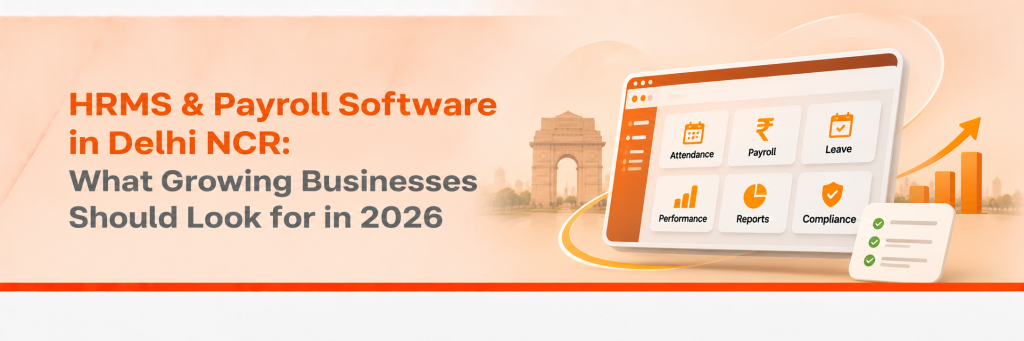
HRMS & Payroll Software in Delhi NCR: What Growing Businesses Should Look for in 2026
HRMs Software, Payroll software
ReadDiscover Why OpportuneHR is the best HRMS Software in India! Schedule a Demo OR Call us @ +91 7700-954949


 Visited 0 times


Imagine it’s the last working day before salaries are processed.
The HR team is busy checking attendance records, following up with managers for approvals, updating employee information, and fixing payroll errors. One employee has not submitted leave details. Another has incorrect bank account information. There is also a mismatch between attendance records and salary calculations.
Now imagine your HR software automatically identifies these issues, prepares a list of problems, and alerts the right people.
That’s the idea behind Agentic AI.
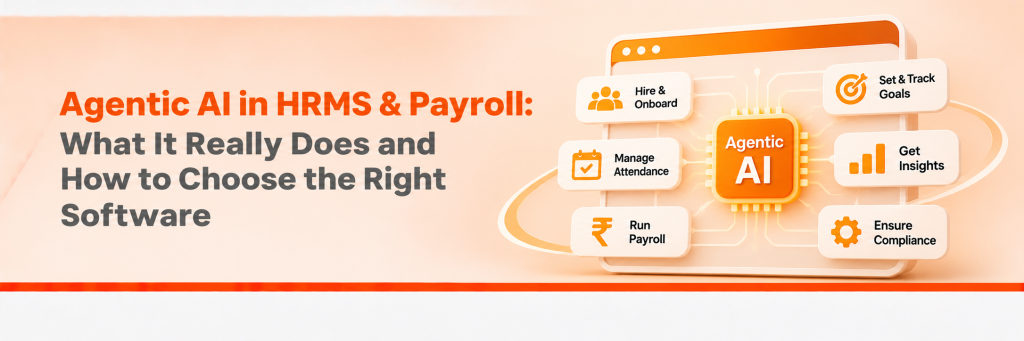
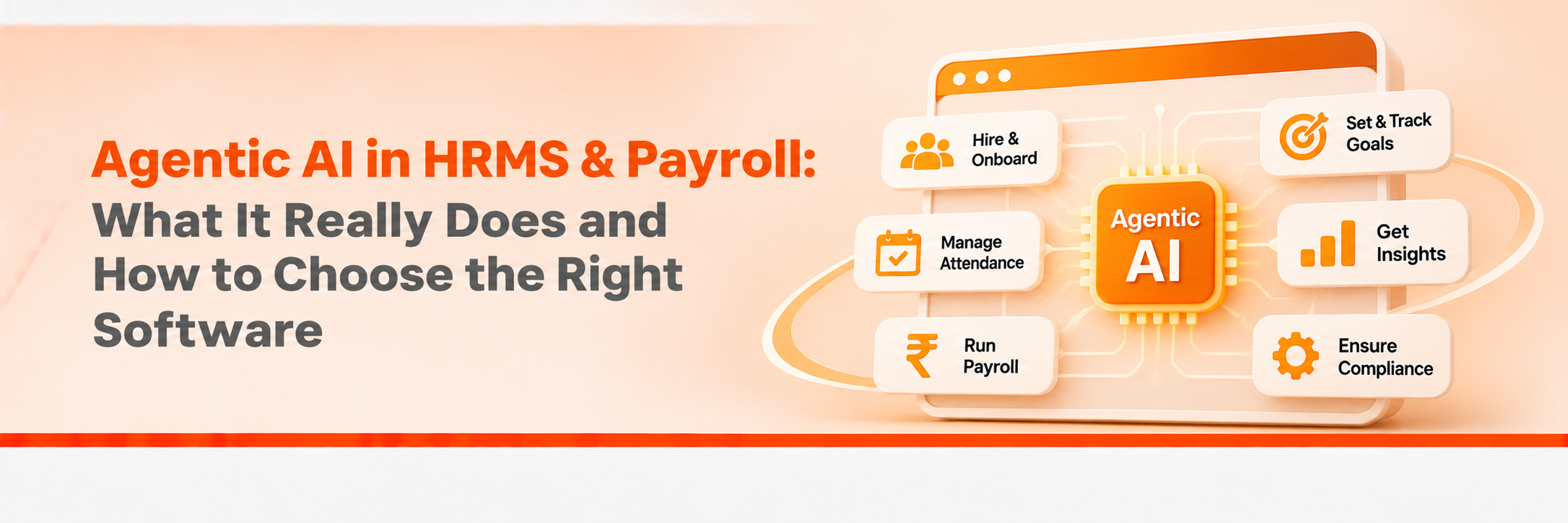
Unlike traditional software that only stores information, agentic AI can help complete tasks and support HR teams in their daily work.

Let’s keep it simple.
A normal HRMS follows fixed rules.
For example:
An AI chatbot can answer simple questions like:
“How many leaves do I have left?”
Agentic AI goes a step further.
It can:
Example
An HR manager asks:
“Show me employees with incomplete attendance records and inform their managers.”
A regular chatbot might tell the manager how to download a report.
An AI agent could:
The key difference is simple:
A chatbot gives information. An AI agent helps get work done.
Attendance management often becomes stressful at month-end.
Employees forget to punch in or punch out. Managers delay approvals. HR spends hours checking records.
Agentic AI can help by:
Example
Instead of manually reviewing 500 attendance records, the AI can highlight only the employees who need attention.
This saves time and reduces manual work.
However, the AI should not automatically mark someone absent or deduct salary without proper approval.
Payroll is one area where accuracy is critical.
Before salary processing begins, HR teams must verify:
An AI-enabled payroll system can help by:
Example
Suppose an employee’s salary suddenly decreases by ₹8,000.
Instead of discovering the issue after receiving a complaint, the AI can flag the change before payroll is processed.
This allows the payroll team to investigate and correct errors early.
Important Note
AI should assist payroll teams, not replace them.
Final approval of payroll, salary payments, statutory deductions, and bank transfers should always remain with authorized employees.
HR teams often receive the same questions repeatedly.
For example:
An AI assistant can answer these questions instantly.
A more advanced AI system can also help employees complete certain tasks, such as:
This reduces the workload on HR teams and gives employees faster responses.
Security Matters
Employees should only be able to access their own information.
The AI must respect user permissions and data privacy rules.
Recruitment involves many activities, including:
Agentic AI can support recruiters by:
Important Reminder
AI can support hiring decisions but should not make hiring decisions.
The final decision should always be made by recruiters and hiring managers.
For many years, companies mainly looked for features such as:
Today, businesses are asking different questions:
This shift is driving interest in agentic AI.
However, businesses should not assume that every AI feature provides the same level of automation.
Some systems only answer questions, while others can actively help with workflows.
Before choosing an AI-enabled HRMS, ask vendors these important questions.
Ask for a live demonstration.
For example:
Can the system identify pending attendance approvals and notify managers automatically?
Or does it simply show users where to find reports?
Check whether the AI can work across:
A system that connects multiple HR functions can provide greater value.
Not everyone should see the same information.
Managers, employees, HR executives, and payroll administrators require different access levels.
Make sure the AI respects these permissions.
Good systems maintain an activity log.
You should be able to see:
This improves transparency and accountability.
HR systems store sensitive information such as:
Ask vendors:
Data security should always be a priority.
This is especially important for Indian businesses.
Make sure the system can handle:
A general AI solution may understand payroll concepts but may not be equipped to manage Indian payroll requirements accurately.
When introducing AI, avoid trying to automate everything immediately.
Some HR decisions require human understanding and judgment.
For example:
AI can help identify patterns and streamline work, but people should continue making important decisions.
Start with routine tasks and expand gradually based on results.
OpportuneHR offers AI-powered assistance through OpportuneOCare, helping users navigate the HRMS and find information more easily.
It is useful for businesses looking to simplify everyday HR activities and improve user support within the platform.
Organizations should evaluate AI features carefully and understand the difference between:
Both have value, but they serve different purposes.
Agentic AI has the potential to change how HR teams work.
Instead of spending hours searching reports, checking records, and sending reminders, HR professionals can rely on AI to handle repetitive tasks and highlight important issues.
This is especially useful in areas such as:
However, the most important question is not:
“Does this HR software have AI?”
The better question is:
“What real work can the AI help my team complete?”
The best AI solutions help HR professionals save time, reduce manual effort, and improve accuracy, while still keeping human judgment, approvals, and accountability at the center of every important decision.
If you’re exploring HRMS solutions, look for practical value, strong security, and AI features that genuinely make HR and payroll management easier
1. What is agentic AI in HRMS and payroll software?
Agentic AI is an advanced form of AI that can understand requests, gather information from different HR and payroll modules, identify issues, and help complete tasks. Unlike traditional software, it does more than provide information; it assists in getting work done.
2. How is agentic AI different from traditional HR chatbots and AI-powered HR automation?
Traditional HR chatbots mainly answer employee questions, while HR automation follows predefined rules and workflows. Agentic AI goes a step further by analyzing data, making recommendations, identifying exceptions, and helping execute multi-step tasks across HR and payroll processes.
3. How can agentic AI help businesses automate payroll processing and HR operations?
Agentic AI can help by identifying attendance discrepancies, flagging payroll exceptions, tracking pending approvals, sending reminders, generating reports, supporting employee queries, and streamlining routine HR tasks. This reduces manual effort and improves efficiency while keeping humans in control of final decisions.
4. Is it safe to use AI-powered payroll software for handling employee salary and personal data?
Yes, provided the software includes strong security controls, role-based access permissions, audit trails, data encryption, and compliance with applicable data protection regulations. Businesses should evaluate vendors carefully to ensure employee information remains secure and access is properly controlled.