November 19, 2026
Agentic AI in HRMS & Payroll: What It Really Does and How to Choose the Right Software
HRMs Software, Payroll software
ReadDiscover Why OpportuneHR is the best HRMS Software in India! Schedule a Demo OR Call us @ +91 7700-954949


 Visited 1 times


It is the last week of the month. The accounts team is waiting for the payroll figures, employees are checking their leave balances, and HR is still following up with department managers for attendance approvals.
One employee has missed a punch. Another has worked overtime. A new employee’s salary details need to be checked, and someone has just submitted a request to correct their attendance.
For a small HR team, these may sound like ordinary tasks. But when you have 200, 500 or 1,000 employees, managing all of this manually can become exhausting.
This is a common challenge for growing businesses in Ahmedabad. Whether it is a manufacturing unit, textile business, pharmaceutical company, trading firm, hospital or IT company, managing people and payroll takes time.
That is why more employers are exploring HRMS software in Ahmedabad.
The purpose is not simply to replace Excel with another software. It is to make everyday HR work easier, reduce repeated data entry and help businesses manage employee information and payroll more accurately.
Let’s look at what Ahmedabad businesses should consider before choosing an HRMS in 2026.

Many businesses start with simple systems.
Attendance is recorded through a biometric machine. Leave requests come through email or WhatsApp. Employee details are maintained in Excel, while payroll is handled using a separate application.
When the employee count is small, this arrangement may work.
But as the business grows, small problems start appearing.
For example, the attendance team may share one report, while the payroll team works with another. A manager may approve leave over WhatsApp, but nobody updates the leave record. An employee’s salary revision may be shared with accounts but missed in the payroll file.
These are not major technology problems. They are everyday coordination problems.
And they take up a lot of HR time.
With HRMS software in Ahmedabad, businesses can bring employee records, attendance, leave and payroll information together. Instead of checking different files, HR can work from one system.
This becomes especially useful for companies managing employees across multiple offices, factories, branches or shifts.
Not every company needs every HR module. A business with 50 employees may have very different needs from a manufacturing company with 800 employees working in different shifts.
However, there are a few basic features worth looking for.
1. Attendance Management that works with your Shifts
Attendance is often the first process that creates problems for HR.
In Ahmedabad, businesses may have office employees, factory workers, sales teams and field staff. They may not all follow the same working hours.
A good attendance system should support:
For example, a manufacturing unit may have three shifts, while its office staff follow regular working hours. HR should be able to manage both without maintaining separate attendance sheets.
It is also useful if approved attendance data can flow directly into payroll. This reduces the need to enter the same information twice.
2. Payroll Software that Handles more than Salary Calculations
Salary processing involves much more than calculating basic pay and allowances.
HR and payroll teams have to consider attendance, leave, loss of pay, overtime, incentives, reimbursements, new joiners, resignations and statutory deductions.
For businesses looking for payroll software in Ahmedabad, it is important to check whether the system can manage the complete salary process.
Look for features such as:
The software should also allow the payroll team to review salary changes and deductions before the final salary run.
After all, employees expect their salaries to be correct and on time. A good payroll process helps HR avoid unnecessary corrections and salary-related complaints.
One important area for businesses in Ahmedabad is Gujarat professional tax payroll.
Professional Tax (PT) is a state-level tax on certain professions, trades and employment. For salaried employees, the employer generally deducts the applicable amount from salary and deposits it with the state as required.
The current Gujarat salary and wage slab listed by the state is:
| Monthly salary or wages | Professional Tax |
| Up to ₹12,000 | Nil |
| More than ₹12,000 | ₹200 per month |
These rates are listed in the Gujarat government’s official Professional Tax schedule and have been effective since 1 April 2022. <Cite refs={[“turn610900search35”]}/>
For example, if an employee earns ₹30,000 per month, the applicable PT deduction under this salary slab is ₹200 per month.
It may look like a small amount, but when a company has hundreds of employees, missing or incorrect deductions can create problems.
This is why payroll teams should check whether their software supports Gujarat’s PT rules and can generate the required reports.
Businesses should also check their registration, payment and filing requirements rather than assuming that the software alone takes care of every compliance step.
Professional Tax is only one part of payroll compliance.
Depending on the establishment and employee eligibility, businesses may also need to manage:
The exact requirements depend on the type of business, number of employees, salary levels and applicable laws.
For example, a manufacturing company may have different workforce and record-keeping needs from an IT services company.
Employers should also keep track of changes in labour laws and applicable Central and Gujarat notifications. The Labour Codes came into effect in November 2025, so businesses should review their payroll processes and confirm the current rules applicable to their establishments.
A useful HRMS should make it easier to maintain employee information, process payroll and prepare reports. But employers should still have a compliance review process in place.
Here is a situation most HR teams will recognise.
An employee calls HR to ask for a payslip. Another wants to know how many leaves are left. Someone else needs to update their bank details.
These are simple requests, but they keep coming throughout the day.
An employee self-service (ESS) portal can reduce these routine calls.
Employees can log in through a web portal or mobile app to:
This gives employees more control over basic HR tasks and allows HR teams to spend less time answering repeated questions.
There are many HRMS providers in the market. Some offer basic attendance and payroll, while others provide a complete HR platform.
So, how do you decide which is the best HR software in Gujarat for your business?
Don’t select software only because it has more features or a good-looking mobile app.
During the product demo, ask the vendor to show how the system handles your actual working situations.
Here are a few questions worth asking:
Can it manage different shifts?
If your company has factory workers, office employees and field staff, check whether different attendance rules can be configured.
Does attendance connect with payroll?
Your payroll team should not have to download attendance reports and enter the same data again.
Can it handle Gujarat compliance?
Ask the vendor to demonstrate Professional Tax calculations and explain how PF, ESI, TDS and other applicable requirements are handled.
Can it manage multiple locations?
If your company has branches or units across Gujarat, check whether you can manage employee records and reports location-wise.
What happens after implementation?
This question is often overlooked. Ask who will help your HR team if there is an issue during payroll processing or if you need help with configuration.
A software vendor should not disappear after the system goes live.
Businesses searching for HRMS companies in Ahmedabad will come across several local and national software providers.
Some may focus mainly on payroll, while others offer attendance, recruitment, performance management and employee self-service as part of a larger HRMS.
Before shortlisting a provider, compare:
It is also a good idea to ask for a demonstration using your own employee structure and salary examples.
A system that works well for one company may not suit another. The right choice depends on your workforce, policies and business needs.
OpportuneHR brings different HR activities together on one platform, including employee management, attendance, leave, payroll, recruitment, onboarding, performance management and employee self-service.
For growing businesses, configurable workflows can help manage different attendance rules, salary structures and approval processes.
The platform also supports Indian payroll requirements, helping HR and payroll teams manage salary processing and related records in one place.
If your organisation is currently using separate tools for attendance, leave and payroll, it may be worth exploring whether a connected system can make these processes easier.
The best way to understand the fit is to see how the software handles your actual HR and payroll requirements.
Managing HR and payroll becomes more challenging as a business grows. More employees mean more attendance records, salary changes, leave requests, approvals and compliance responsibilities.
Trying to manage everything through spreadsheets and separate tools can take up a lot of time.
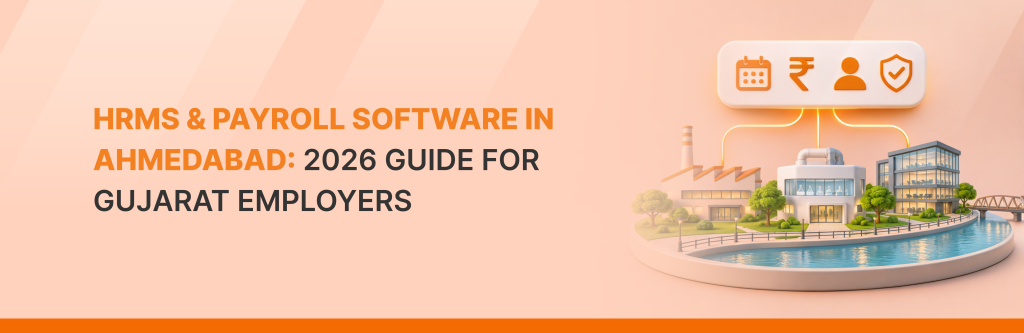
For businesses looking for HRMS software in Ahmedabad, the focus should be on finding a system that is easy to use, supports Gujarat payroll requirements and fits the way the organisation works.
You don’t need software with every possible feature. You need software that solves the problems your HR team faces every month.
Looking to simplify HR and payroll for your Gujarat business? Book a demo with OpportuneHR and see how it can support your organisation’s day-to-day HR processes.
1. Which is the best HRMS and payroll software for businesses in Ahmedabad?
The right HRMS depends on your business size and workforce. For example, an Ahmedabad textile or manufacturing unit may need biometric attendance, shift management, overtime tracking and payroll, while an IT company may focus more on leave management, employee self-service and performance tracking. Look for software that also supports Gujarat Professional Tax, PF, ESI and location-wise reporting. OpportuneHR is one option businesses in Ahmedabad can explore for managing HR and payroll on a single platform.
2. What are the statutory payroll compliance requirements for employers in Gujarat?
Employers in Ahmedabad and other parts of Gujarat need to follow applicable payroll requirements such as Provident Fund (PF), Employee State Insurance (ESI), Professional Tax (PT), TDS and Labour Welfare Fund (LWF). They must also follow applicable minimum wage, wage payment and employment record requirements. Gujarat Professional Tax for salaried employees is currently ₹200 per month when monthly salary or wages exceed ₹12,000, and nil up to ₹12,000. The exact requirements depend on employee eligibility, establishment type and applicable laws.
3. What features should MSMEs in Gujarat look for when selecting HRMS software?
MSMEs in Ahmedabad, Surat, Vadodara and Rajkot should look for HRMS software that can manage employee records, biometric attendance, shift schedules, leave, payroll and statutory deductions. Businesses with factory or multi-location operations should also check overtime management, mobile attendance, department-wise reports and approval workflows. Easy employee self-service and responsive customer support are equally important, especially for companies with small HR teams.
4. How can payroll software help Ahmedabad businesses manage PF, ESI, professional tax and employee salary processing?
Payroll software helps Ahmedabad businesses calculate monthly salaries by bringing together attendance, leave, overtime, incentives and deductions. It can calculate applicable PF and ESI contributions, Gujarat Professional Tax of ₹200 for employees earning above the prescribed monthly threshold, and TDS based on configured tax details. It can also generate payslips, payroll registers, bank transfer files and statutory reports. This is particularly useful for manufacturing, textile and pharmaceutical companies managing large employee groups, as it reduces manual calculations and makes monthly payroll records easier to review.