October 23, 2026
Buying Payroll Software in Mumbai? 7 Questions to Ask Your Vendors
ReadDiscover Why OpportuneHR is the best HRMS Software in India! Schedule a Demo OR Call us @ +91 7700-954949


 Visited 1 times


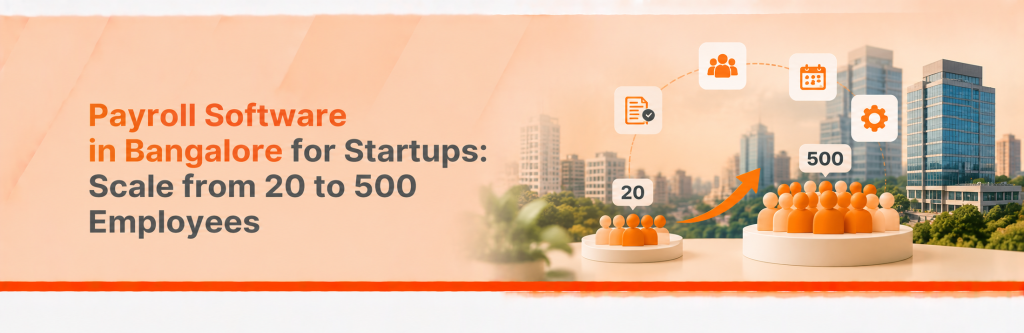
Quick answer: Startup payroll doesn’t get harder gradually. It breaks at specific headcounts. ESI and Karnataka’s Labour Welfare Fund start at 10 employees, PF at 20, and multi-state rules arrive with your first remote hire. Choose payroll software in Bangalore for where you’ll be in 18 months: ESOP tax, variable pay, 2-day final settlements and investor-ready records.

Startup payroll breaks when headcount crosses a legal or operational threshold. The founder’s Excel sheet works at 12 people. At 20, PF becomes mandatory. By 150, you’re running quarterly incentives and ESOP exercises. Good payroll management software for startups should support current payroll requirements while giving the business room to scale as employee numbers and compliance needs change.
| Headcount | New legal duty | What breaks operationally |
| 10 | ESI (for staff earning up to ₹21,000), Karnataka LWF, POSH Internal Committee | The founder can’t remember who’s covered by what |
| 20 | PF registration becomes mandatory | Excel formulas break with every new salary structure |
| 50 | Crèche facility required (King Stubb & Kasiva) | First hires outside Karnataka; finance wants cost-centre reports |
| 150 | No new statutory trigger | Batch hiring, quarterly variable pay, the first ESOP exercises |
| 300 to 500 | Multiple entities and states | Auditors, investor due diligence, strict access controls |
Take a hypothetical Koramangala SaaS startup that grew from 35 to 140 people in 14 months. In that time, it crossed the ESI, PF and crèche thresholds, hired in Pune and Hyderabad, and ran its first ESOP buyback. The payroll setup that worked at 35 failed four times along the way.
The old advice was to pick the cheapest tool at 20 people and switch later. That’s wrong now, because switching mid-year means carrying over every employee’s TDS and PT balances by hand.
Bengaluru startups need payroll that handles Karnataka’s updated rules, pays variable pay and ESOPs correctly, settles exits fast and connects to their finance stack. Most payroll software in India handles PF, ESI and TDS. The difference shows in state rules, equity and speed.
Karnataka changed both in 2025-26. Professional tax is now ₹200 a month for salaries of ₹25,000 and above, and ₹300 in February. That’s ₹2,500 a year, effective 1 April 2025 (Lexplosion).
The Labour Welfare Fund now applies to establishments with 10 or more employees, down from 50. This took effect on 7 January 2026 (Sansa Legal). The yearly contribution is now ₹50 per employee and ₹100 from the employer (King Stubb & Kasiva).
We registered for LWF two years ago. Does anything change? Yes, the rates. Check that your software uses ₹50 and ₹100, not the old ₹20 and ₹40.
Because statutory requirements vary by state, startups should confirm that their payroll configuration reflects the applicable Karnataka rules. Payroll compliance software can help manage state-specific calculations and maintain relevant compliance records
Variable pay: Quarterly incentives are taxed in the month they’re paid. A large payout can push TDS up sharply that month, so employees see a smaller-than-expected payslip. Good software spreads the tax across the remaining months of the year.
ESOPs: When an employee exercises options, the gain is taxed as salary that month. The employer must deduct TDS (Treelife).
But no cash changed hands, so who pays the TDS? The employer must either collect it from the employee or sell some shares to cover it. For an unlisted startup, finding a buyer for those shares is hard. That’s why DPIIT-recognised startups can opt in to defer this TDS for up to 48 months, or 60 months for shares allotted from April 2026. The deferral isn’t automatic, so your payroll system must track it.
Fast onboarding: When 25 people join in one week, offer letters, bank details, PF numbers and tax declarations all need to be collected before payroll closes. Self-service onboarding saves HR from chasing each one.
Fast exits: Under the Code on Wages, final wages are due within 2 working days of someone leaving (LiveLaw). If someone resigns and their last day is Friday, you pay by Tuesday. Gratuity has a separate 30-day deadline.
A structured exit workflow helps HR coordinate resignation approvals, final salary calculations, leave encashment and employee documentation. See our guide to managing the employee exit process for a practical checklist.
Many startups pay early hires as “consultants”, with 10% TDS under section 194J. That’s risky once those people work fixed hours under a manager, because they may legally count as employees. Move them onto payroll before your next funding round, when due diligence will raise the question anyway.
Remote hires bring a second issue. Professional tax depends on where the employee works, not where your office is. A Hyderabad hire falls under Telangana’s rules, and a Pune hire under Maharashtra’s. The software should switch states automatically when you set each employee’s work location.
Payroll should connect to your HRIS, accounting software and bank, so nobody retypes numbers between systems. Automated payroll processing only saves time when salary journals post straight to Zoho Books or Tally by cost centre.
Access matters as much as integration. Founder and leadership salaries shouldn’t be visible to every HR executive. Role-based access, with an audit log of who viewed what, also helps you prepare for India’s data protection rules. Most of those obligations apply from 13 May 2027 (SCC Online).
The old advice was that payroll data lives with HR. That’s wrong now, because investors ask for PF challans, TDS returns and the ESOP register in every funding round. Keep a diligence pack ready to export.
Different features matter at different sizes. At 20 people, accurate statutory deductions are enough. At 150, you need variable pay and ESOP handling. By 500, multi-entity payroll and access controls matter most. Use this scorecard to choose a payroll management system that still fits two stages from now.
| Feature | 20 to 50 | 50 to 150 | 150 to 500 |
| PF, ESI, Karnataka PT and LWF | Must-have | Must-have | Must-have |
| Employee self-service and mobile payslips | Should-have | Must-have | Must-have |
| Multi-state PT by work location | Not yet | Must-have | Must-have |
| Variable pay and incentive tax spreading | Not yet | Must-have | Must-have |
| ESOP exercise TDS and deferral tracking | Not yet | Should-have | Must-have |
| Accounting and bank integration | Should-have | Must-have | Must-have |
| Role-based access with audit log | Should-have | Must-have | Must-have |
| Multi-entity payroll | Not yet | Not yet | Must-have |
Don’t pay for “not yet” features at 30 people. But do check that the vendor can switch them on later without a migration.
Most vendors charge per employee per month, either through a flat plan or tiered pricing. Before choosing payroll software pricing in India, compare the cost at multiple headcounts and include implementation, integrations, additional modules and support.
Here’s an illustrative example. A plan at ₹80 per employee a month costs ₹4,000 at 50 people and ₹40,000 at 500. If the ESOP module, multi-entity setup and accounting integration are add-ons, the real figure at 500 can be much higher.
The main implementation risks for startups:
Our 90-day HRMS implementation plan covers migration step by step.
Founders should ask questions that test whether the software will survive the next two growth stages, not just today’s payroll. Ask each vendor to answer on screen, using your real salary structures.
Before comparing vendors, use a payroll software comparison guide to review features, statutory compliance, integrations, reporting and support.
Moving systems at 300 costs far more than choosing well at 50.
Mistakes here show up as interest and penalties on TDS.
The 2-day rule leaves no time for manual calculations.
It’s the only way to see the year-three bill today.
Otherwise finance retypes payroll every month.
Salary leaks damage trust faster than salary errors.
A slow data room delays term sheets.
OpportuneHR has built HR and payroll tools for Indian companies for over a decade. More than 250 companies and 2.5 lakh users rely on it every payday.
What OpportuneHR covers:
The approach is what sets it apart. OpportuneHR configures the system around your company’s HR scenarios before go-live, so you don’t bend your policies to fit the software. Its implementation and support team, Opportune.Care, reports a 98% client retention rate.
OpportuneHR works with IT and ITES companies, manufacturers, BFSI firms, healthcare and diagnostic centres, hospitality groups, retailers, manpower services companies and direct sales teams.
Looking for payroll software in Bangalore that grows with you from 20 to 500 employees? Talk to the OpportuneHR team. Call or WhatsApp +91 7700-954949, email admin@opportune.in, or book a free demo.
When should a startup buy payroll software?
Buy it before crossing 20 employees, when PF registration becomes mandatory. Buy it sooner if you hire in another state, run variable pay or plan an ESOP pool. Switching at the start of a tax year, in April, avoids carrying over TDS balances.
Can payroll scale to 500 employees?
Yes, if the system supports multi-state PT, variable pay, ESOP tax and multiple entities. Good HR and payroll software handles 500 employees with the same monthly steps as 50. Check this in the demo by asking the vendor for a reference customer at your target size.
Which integrations should a CTO test?
Test the HRIS or applicant tracking system, single sign-on, accounting software, bank payout files and the ESOP cap table tool. Ask for API documentation and a sandbox. Then run a full month of real data through each integration, including edge cases like mid-month joiners.
How are bonuses handled?
Bonuses and incentives are taxed as salary in the month they’re paid. Good payroll software recalculates the year’s tax and spreads it across the remaining months, so one payslip doesn’t take the whole hit. Statutory bonus under the Code on Wages is calculated separately, for eligible employees.
What are the hidden implementation costs?
The common ones are setup fees, data migration, add-on modules such as ESOPs, and integration charges. Others are extra fees per entity and internal time for parallel runs. Mid-year switches add work to carry over TDS and PT balances. Ask for all of these in the written quote.