
September 21, 2026
Shift & Roster Management Software: Building Schedules That Actually Hold
ReadDiscover Why OpportuneHR is the best HRMS Software in India! Schedule a Demo OR Call us @ +91 7700-954949


 Visited 30 times


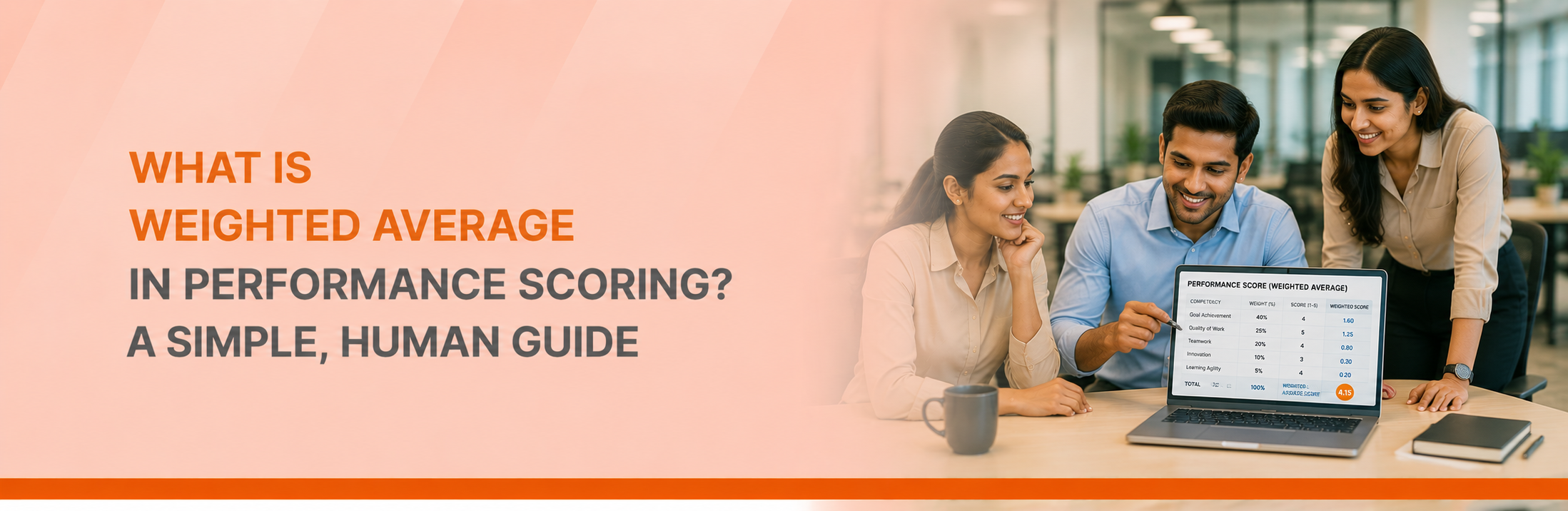
Performance reviews are rarely as simple as giving someone a single score.
An employee might be excellent at teamwork, strong in communication, average in target achievement, and still learning leadership skills. So the question becomes:
Should every performance area carry the same importance?
Probably not.
That’s exactly why many organizations use something called a Weighted Average in performance scoring.
It helps companies evaluate performance more fairly by giving different importance—or “weight”—to different criteria.
And honestly, once you understand it, it’s much simpler than it sounds.

A Weighted Average in performance scoring is a method where different performance areas are assigned different levels of importance while calculating an employee’s final score.
In simple words: Not every performance factor is treated equally—some areas matter more than others.
Because all goals are not equally important.
For example:
If every category had equal value, the final rating might not reflect actual business priorities.
Weighted scoring creates balance.
Let’s say an organization evaluates employees on three areas:
| Performance Area | Weight | Employee Score |
|---|---|---|
| Goal Achievement | 50% | 8/10 |
| Teamwork | 30% | 9/10 |
| Communication | 20% | 7/10 |
Instead of simply averaging all scores equally, each score is multiplied by its assigned weight.
That means:
This creates a more realistic performance evaluation.
Because performance is not one-dimensional.
An employee’s role, responsibilities, and business impact all matter differently.
Weighted scoring helps HR:
It ensures the final rating reflects what actually matters most.
Without weighted scoring, all performance categories are treated equally—even when they shouldn’t be.
For example:
Weighted average brings realism into the review process.
Employees naturally focus more on areas with higher importance.
This helps organizations guide performance toward:
Employees understand what the organization values most.
When weights are clearly defined:
Transparency reduces confusion and frustration during reviews.
Different roles require different priorities.
For example:
Weighted scoring allows performance systems to feel more relevant and personalized.
Yes—if it’s not designed properly.
Problems happen when:
The key is balance and communication.
Employees should clearly understand:
Managing weighted scoring manually through spreadsheets can become complicated very quickly.
Especially when:
This is where HRMS Software becomes extremely valuable.
With the right HRMS Software, organizations can:
It reduces manual errors and makes the entire review process smoother and more reliable.
Even a good scoring system can fail if the process is unclear.
Some common mistakes include:
The best performance systems are simple, transparent, and easy to understand.
Weighted Average in performance scoring is not just about numbers—it’s about fairness and clarity.
It helps organizations evaluate employees based on what truly matters for their role and business impact.
When done correctly, it creates:
And with the support of the right HRMS Software, weighted scoring becomes much easier to manage, track, and scale across teams.
At the end of the day, employees don’t just want ratings.
They want evaluations that feel fair, transparent, and connected to the work they actually do.