October 3, 2026
HR & Payroll Software for Manufacturing Companies in India
ReadDiscover Why OpportuneHR is the best HRMS Software in India! Schedule a Demo OR Call us @ +91 7700-954949


 Visited 30 times


If you’ve ever gone through a performance review and wondered,
“Why can’t everyone be rated fairly based on their work?”—you’ve probably come across the – Bell Curve.
It’s one of those concepts that sounds structured on paper… but feels a bit complicated in real life. Most HRMS software uses it as a default rating method—yet few people actually explain what it means.
Let’s break it down in a simple way that makes sense.

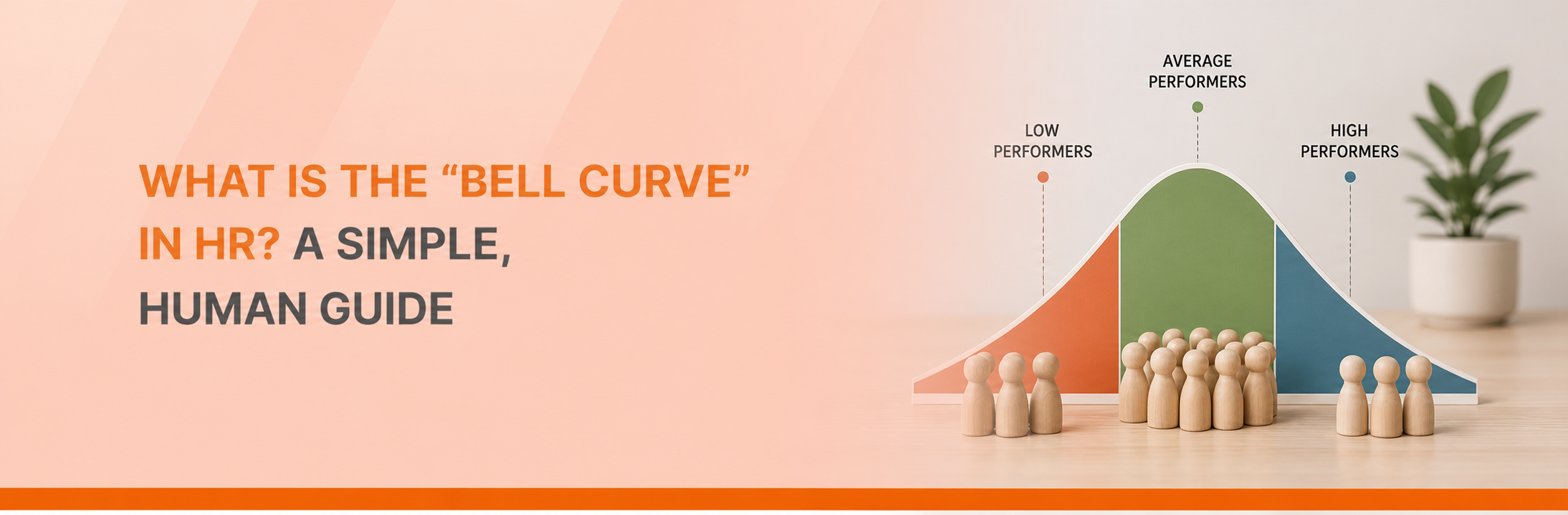
The Bell Curve in HR is a performance rating method where employees are distributed across categories—top performers, average performers, and low performers.
In simple terms: It ranks employees relative to each other, not just based on their individual performance.
Because when employee ratings are plotted on a graph, they form a shape like a bell.
Most people fall in the middle—just like the shape of a bell.
In many organizations, ratings are distributed something like this:
Here’s the key thing to understand:
Even if most of your team performs well, the system may still require some people to be placed in lower categories.
And that’s where concerns usually begin.
On the surface, it solves a real problem—rating inflation.
Sometimes managers rate everyone highly to avoid difficult conversations. The Bell Curve forces differentiation.
It helps organizations:
The intention is fairness through structure.
When used carefully, it can bring some clarity.
1. Clear differentiation:
Managers have to think critically about performance—not just give everyone similar ratings.
2. Better talent visibility
Top performers stand out more clearly.
3. Structured decision-making
Helps with compensation, promotions, and succession planning.
This is where things get real.
1. It can feel forced
Even if your entire team performs well, someone still has to fall into the “low performer” group. That doesn’t always reflect reality.
2. It can affect team culture
Instead of collaborating, employees may start comparing themselves to each other. Healthy teamwork can turn into competition.
3. It doesn’t consider context
Some teams are stronger than others. Some roles are harder to measure. A fixed distribution doesn’t always fit every situation.
4. It can impact motivation
Being rated lower due to a system—not actual performance—can feel discouraging.
This is a question many HR leaders are asking.
The answer is: partially.
Some organizations still use it, but many are moving toward:
The shift is from ranking people to growing people.
Instead of using it strictly, many HR teams are adapting it.
A more balanced approach includes:
The goal is fairness—not forced categorization.
Managing performance manually—especially with structured models like the Bell Curve—can quickly become complicated.
This is where HRMS Software plays a key role.
With the right HRMS, you can:
It helps managers focus less on distribution—and more on meaningful feedback.
The Bell Curve was designed to bring structure and consistency to performance evaluations.
And while the intention makes sense, today’s workplaces need something more flexible and human.
Because performance is not just about comparison—it’s about growth, context, and potential.
The real question HR should focus on is:
“Are we helping our people improve and succeed?”
When supported by the right HRMS Software, organizations can move toward a more transparent and balanced approach—where performance is not forced into categories, but truly understood.
At the end of the day, people don’t just want to be rated.
They want to be recognized, guided, and given a fair chance to grow.