October 9, 2026
HR & Payroll Software for Retail Businesses: Multi-Store Workforce Guide
HRMs Software, Payroll software
ReadDiscover Why OpportuneHR is the best HRMS Software in India! Schedule a Demo OR Call us @ +91 7700-954949


 Visited 59 times


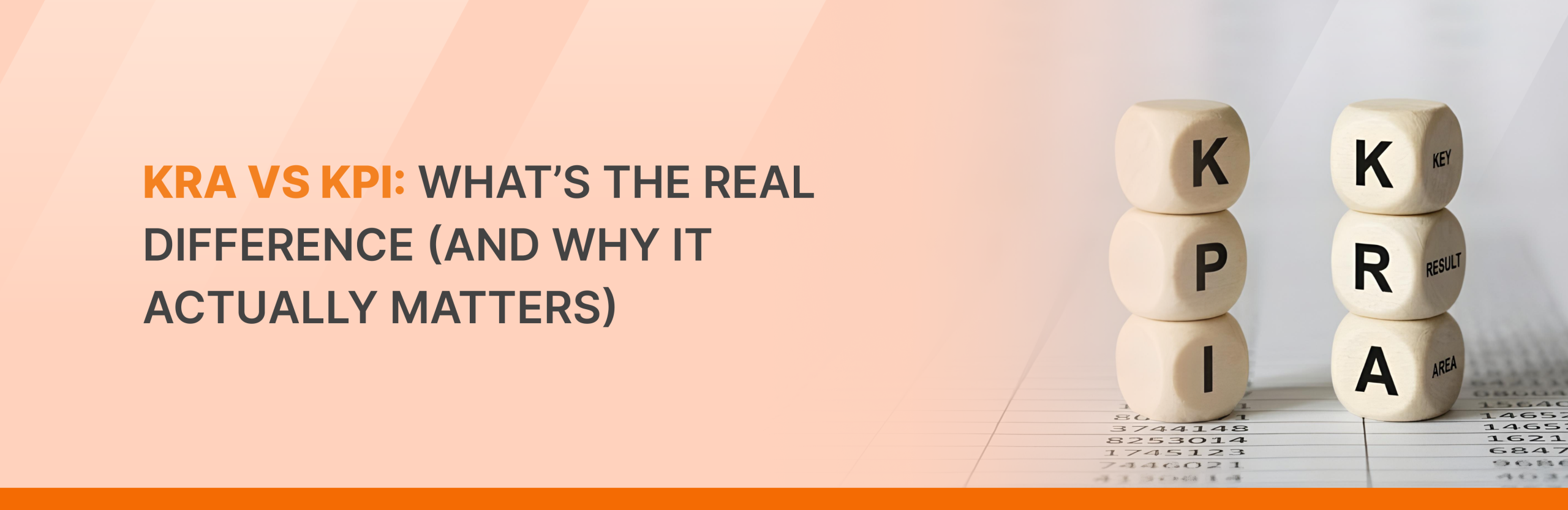
Let’s be honest — most of us have heard the terms KRA and KPI in meetings, appraisal discussions, or HR conversations… and quietly wondered:
“Aren’t they basically the same thing?”
You’re not alone.
Even in many organizations, KRAs and KPIs get mixed up. But once you truly understand the difference, performance management starts making a lot more sense — for both managers and employees.
Let’s simplify it.

KRA stands for Key Result Area.
Instead of thinking of it as something complex, just think of KRAs as:
The core responsibilities of your role
It answers a simple question:
“What am I supposed to focus on in this job?”
For example, if you’re in HR, your KRAs might look like:
Notice something?
These are important — but they’re not measurable yet.
They’re more like zones of responsibility.
KPI stands for Key Performance Indicator.
Now this is where things become measurable.
KPIs answer the question:
“How well am I doing in those responsibilities?”
Taking the same HR example:
So while KRAs give you direction, KPIs give you clarity.
If you remember just one thing, remember this:
Or even simpler:
KPIs are numbers that track performance
Because in real workplaces, these terms are often used interchangeably.
A manager might say:
“Your KPI is recruitment.”
But recruitment is not a KPI — it’s a KRA.
The actual KPIs would be things like:
This confusion leads to unclear expectations… and honestly, a lot of frustration during appraisals.
Here’s where it becomes important.
Imagine being told:
“You need to improve your performance.”
But no one tells you how that performance is being measured.
That’s what happens when KPIs are missing.
On the other hand, if you only track numbers without defining KRAs, employees may hit targets without focusing on what truly matters.
When KRAs and KPIs are clearly defined:
This is also why many companies now rely on HRMS software — it helps connect KRAs to KPIs and makes tracking seamless instead of manual and confusing.
Let’s say you’re a sales executive.
Your KRA is simple:
Generate revenue
But how do you know if you’re doing well?
That’s where KPIs come in:
Now instead of vague feedback like:
“Try to improve sales…”
You get something actionable:
“Your conversion rate dropped this month — let’s look at why.”
That’s a completely different conversation.
From what we see across teams, here are a few common pitfalls:
Fixing just these can significantly improve how your team performs.
You don’t need a complex framework. Just keep it simple:
And if you’re scaling, using an HRMS tool can save a lot of manual effort.
Think of it like this:
KRAs are your destination.
KPIs are your Google Maps — showing whether you’re on track or not.
Without KRAs, you don’t know where you’re going.
Without KPIs, you don’t know if you’re getting there.
When both work together, performance management stops feeling like a formality… and actually starts driving real results.